Open Repository • 100 Vectors • AI-Native (llms.txt)

Core Mental Models & Strategic Diagrams

A minimalist visual index of 100 cognitive and systems frameworks. Pure SVG and transparent PNG formats for slide design, documentation, and conceptual communication.

/
Showing 100 of 100 models Resolution: 1024x1024 / Vector

#001 The 2x2 Matrix

Strategy

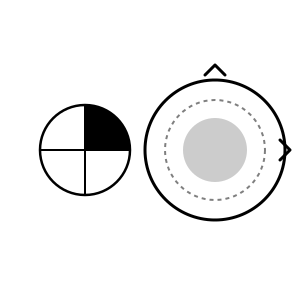
Mapping initiatives along Impact vs Effort axes to systematically separate High-Value Quick Wins from low-leverage time sinks. • Memetakan inisiatif pada sumbu Dampak vs Tenaga untuk memisahkan Quick Wins bernilai tinggi dari tugas penguras waktu.

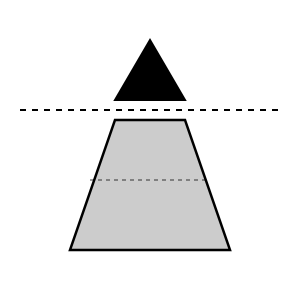
#002 The Iceberg Model

Strategy

Surface symptoms represent only 10% of reality; durable problem-solving requires addressing structural rules and systemic mental models beneath. • Gejala yang terlihat hanyalah puncak masalah; intervensi nyata menuntut perbaikan pada struktur dan pola sistem di bawah permukaan.

#003 Inversion Thinking

Strategy

Instead of planning forward for success, invert the problem by defining every possible failure mode and systematically eliminating them. • Alih-alih mencari cara untuk sukses, petakan seluruh faktor penyebab kegagalan fatal dan eliminasi satu per satu secara metodis.

#004 Three Horizons Framework

Strategy

McKinsey's growth framework: Defend core cash-flow engines (H1), nurture emerging bets (H2), and fund long-term transformative options (H3). • Alokasi modal strategis McKinsey: Pertahankan bisnis inti hari ini (H1), akselerasi pertumbuhan baru (H2), dan biayai opsi masa depan (H3).

#005 Pyramid Principle

Strategy

Minto's executive structure: Deliver the bottom-line recommendation first, supported by a MECE grouping of evidence underneath. • Struktur komunikasi eksekutif Barbara Minto: Sampaikan kesimpulan di kalimat pertama, lalu dukung dengan 3 argumen logis independen.

#006 First Principles Thinking

Strategy

Stripping away reasoning by analogy down to bedrock physical truths, then reasoning upward to construct novel solutions. • Membongkar asumsi konvensional hingga ke fakta sains/logika paling mendasar, lalu merekayasa solusi baru yang orisinal.

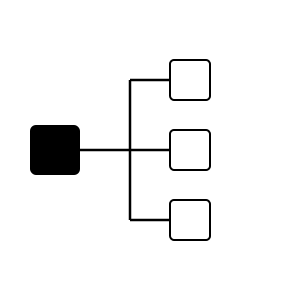
#007 MECE Tree Breakdown

Strategy

Rigorous analytical taxonomy: Segmenting problems into non-overlapping branches that comprehensively account for all possibilities. • Dekomposisi analitis tanpa celah (Mutually Exclusive, Collectively Exhaustive): Tiap cabang berdiri mandiri tanpa ada data yang tumpang tindih.

#008 Circle of Competence

Strategy

Buffett's competence law: Superior alpha comes from remaining strictly within the boundaries of what you genuinely comprehend. • Prinsip alokasi modal Warren Buffett: Keuntungan asimetris tercipta dari disiplin untuk hanya bermain di dalam batas kompetensi sejati Anda.

#009 Second-Order Thinking

Strategy

Evaluating decisions not by their immediate first-order payoff, but by the chain of systemic feedback loops they trigger thereafter. • Membedah rantai kausalitas: Menilai kebijakan bukan dari efek langsung sesaatnya, melainkan dari reaksi sistemik jangka panjang berikutnya.

#010 Strategy Trade-Offs

Strategy

Porter's competitive strategy: Deliberately choosing what NOT to do in order to establish and protect an uncontested position. • Esensi strategi menurut Michael Porter: Keberanian menolak peluang bagus yang tidak selaras demi melindungi diferensiasi posisi pasar.

#011 The Strategy Funnel

Strategy

Filtering total market potential into focused segments and qualified opportunities. • Penyaringan dari pasar luas (TAM) menjadi segmen terfokus hingga transaksi nyata.

#012 Porter's Five Forces

Strategy

Five competitive industry forces shaping long-term profitability. • 5 kekuatan persaingan yang menentukan profitabilitas jangka panjang suatu industri.

#013 Blue Ocean Strategy

Strategy

Creating uncontested market space rather than competing in crowded red oceans. • Menciptakan ruang pasar baru yang belum terjamah alih-alih bertarung di lautan merah.

#014 Decision Trees

Strategy

Mapping sequential decision branches and probability pathways. • Memetakan konsekuensi dari setiap cabang keputusan dan probabilitas hasilnya.

#015 The Black Swan Event

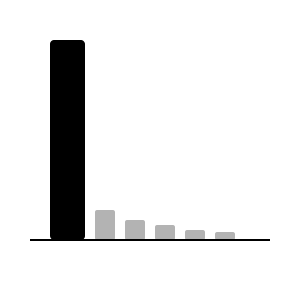
Strategy

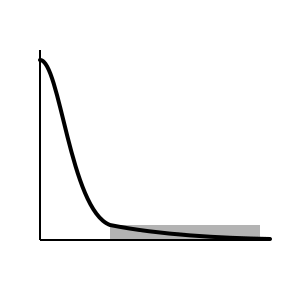
Rare, extreme-impact anomalies that defy standard Gaussian models. • Peristiwa langka berdampak raksasa yang diabaikan oleh kurva probabilitas normal.

#016 The Lindy Effect

Strategy

The longer a non-perishable idea has survived, the longer its expected future lifespan. • Semakin lama sebuah ide/buku telah bertahan, semakin lama usianya di masa depan.

#017 Chesterton's Fence

Strategy

Never remove a barrier until you fully understand why it was built initially. • Jangan merobohkan pagar pembatas sebelum memahami alasan awal kenapa pagar itu dipasang.

#018 Asymmetric Risk/Reward

Strategy

Capping downside risk while maintaining unlimited upside potential. • Kerugian maksimal terbatasi, sementara potensi keuntungan tidak terbatas.

#019 The Red Queen Effect

Strategy

Running as fast as possible just to maintain relative position in an evolving market. • Anda harus berlari kencang hanya untuk mempertahankan posisi Anda saat ini.

#020 The Map is Not the Territory

Strategy

Models and slides are simplified representations, not the reality of the terrain. • Slide dan dokumen hanyalah penyederhanaan dari realitas lapangan yang dinamis.

#021 The Growth Flywheel

Growth

A compounding growth engine where small sequential operational wins reinforce and accelerate each subsequent cycle. • Roda gila pertumbuhan: Setiap inisiatif operasional memberi makan dan melipatgandakan momentum putaran inisiatif berikutnya.

#022 The S-Curve Transition

Growth

Navigating inflection points by investing in next-generation S-curves before the incumbent engine reaches market saturation. • Disrupsi kurva S: Berinvestasi pada paradigma teknologi baru sebelum kurva pertumbuhan bisnis saat ini mencapai titik jenuh.

#023 The Compound Effect

Growth

The mathematics of compounding: A 1% marginal daily improvement yields a 37-fold exponential leap over 365 days. • Hukum pelipatgandaan: Kemajuan marginal 1% setiap hari berlipat ganda menjadi 37 kali lipat pertumbuhan performa dalam satu tahun.

#024 Network Effects

Growth

Metcalfe's platform law: Network value scales quadratically (N²) relative to the addition of each participating node. • Hukum Metcalfe: Nilai jaringan berlipat ganda secara kuadratis (N²) terhadap pertambahan setiap pengguna aktif baru.

#025 Viral K-Factor

Growth

When each user refers more than one new user, exponential growth occurs. • 1 pengguna mendatangkan > 1 pengguna baru menghasilkan ledakan viral.

#026 Economies of Scale

Growth

Per-unit cost decreases significantly as total production volume increases. • Biaya per unit menurun drastis seiring dengan meningkatnya volume produksi.

#027 The Innovation Chasm

Growth

The dangerous gap between early technology enthusiasts and the pragmatist mass market. • Jurang pemisah antara pengguna antusias awal vs pasar massal yang pragmatis.

#028 Platform Multiplier

Growth

A foundational ecosystem enabling thousands of independent builders to create value. • Fondasi platform yang memungkinkan ribuan kreator lain membangun bisnis di atasnya.

#029 Zero-Sum vs Positive-Sum

Growth

Positive-sum game theory: Generating net-new value that expands the entire pie rather than engaging in destructive margin wars. • Dinamika permainan non-zero-sum: Fokus menciptakan nilai baru yang memperluas ukuran pasar ketimbang memperebutkan kuota yang ada.

#030 The Long Tail

Growth

The cumulative volume of thousands of niche products exceeding top bestsellers. • Akumulasi penjualan ribuan produk niche melampaui omset beberapa produk terlaris.

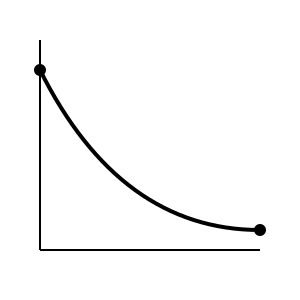
#031 Diminishing Returns

Growth

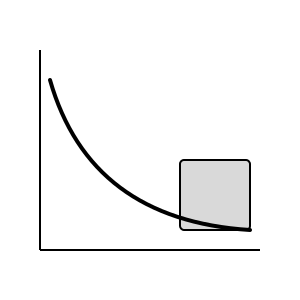
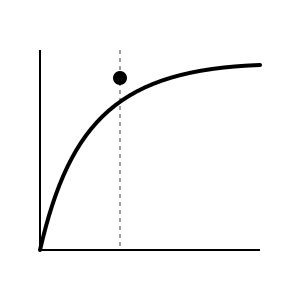
Past the optimal point, each additional unit of input yields progressively smaller output gains. • Setelah titik optimal, penambahan energi hanya menghasilkan sedikit kenaikan output.

#032 Lock-in & Moat

Growth

Defensive competitive moats that increase customer switching costs. • Parit pertahanan bisnis yang membuat pengguna enggan berpindah ke kompetitor.

#033 TAM SAM SOM Funnel

Growth

Three concentric market sizing circles: Total, Serviceable, and Obtainable market. • Tiga lingkaran konsentris ukuran pasar: Total, Servisabel, dan yang bisa Dimenangkan.

#034 The Tipping Point

Growth

The critical threshold where a minor change triggers rapid, self-sustaining adoption. • Titik kritis di mana sebuah tren kecil tiba-tiba meledak menjadi fenomena massal.

#035 Power Law (80/20 Extreme)

Growth

A single venture or outcome generating larger returns than all others combined. • 1 investasi terbaik menghasilkan return lebih besar dari gabungan semua investasi lainnya.

#036 Asymmetric Funnel

Growth

Fixing bottom-funnel churn creates exponentially higher value than increasing top-funnel traffic. • Fokus memperbaiki retensi di bawah funnel lebih menguntungkan dibanding mengisi atasnya.

#037 Value Chain Integration

Growth

Controlling critical sequential links to dictate industry standards and quality. • Menguasai mata rantai kritis dari hulu ke hilir untuk mendikte standar pasar.

#038 Compounding Knowledge

Growth

Each new mental model accelerates the acquisition and retention of future concepts. • Setiap buku dan konsep baru mempercepat daya serap ide-ide berikutnya.

#039 Social Proof Multiplier

Growth

Buyer confidence increases exponentially with verified social validation and reviews. • Kepercayaan calon pembeli meningkat eksponensial seiring bertambahnya bukti testimoni.

#040 The Flywheel Friction

Growth

Eliminating friction points on the growth flywheel rapidly unlocks higher velocity. • Menghilangkan 1 hambatan kecil pada roda pertumbuhan melipatgandakan kecepatan.

#041 Signal vs Noise

Productivity

Attentional filtering: Ruthlessly suppressing ambient noise to direct all cognitive bandwidth toward the single high-impact signal. • Disiplin perhatian: Menyaring 99% distraksi dan opini bising untuk memusatkan energi eksekusi pada 1 prioritas terpenting.

#042 Leverage (Daya Ungkit)

Productivity

Naval Ravikant's leverage doctrine: Utilizing software, media, and capital to achieve non-linear output independent of input hours. • Daya ungkit modal & kode: Menggunakan sistem, media, dan perangkat lunak untuk melipatgandakan hasil kerja tanpa menambah jam kerja fisik.

#043 The Bottleneck

Productivity

Goldratt's constraint theory: The maximum throughput of any pipeline is strictly dictated by the capacity of its single slowest bottleneck. • Theory of Constraints Goldratt: Kapasitas keseluruhan alur produksi sepenuhnya dibatasi oleh titik sumbat terlambat pada sistem.

#044 Deep Work vs Shallow

Productivity

Newport's deep focus: Uninterrupted immersion in cognitively demanding tasks generates rare, high-value, and defensible output. • Deep Work Cal Newport: Kemampuan fokus tanpa interupsi pada tugas kognitif berat menghasilkan karya bernilai tinggi yang sulit ditiru.

#045 Pareto Principle (80/20)

Productivity

Pareto's power law: A vital minority (20%) of input drivers accounts for an overwhelming majority (80%) of strategic outcomes. • Distribusi daya Pareto: 20% faktor input kritis menghasilkan 80% dampak nilai ekonomi dan hasil bisnis.

#046 Focus vs Scattered

Productivity

Dividing energy across 10 directions produces zero breakthrough depth. • Membagi tenaga ke 10 arah menghasilkan 0 terobosan nyata.

#047 Consistency > Intensity

Productivity

Sustainable execution: A disciplined daily operating cadence consistently outperforms heroic bursts followed by cognitive burnout. • Ritme eksekusi: Ritme harian teratur yang dapat dipertahankan jangka panjang mengalahkan lonjakan kerja ekstrem yang berujung burnout.

#048 Parkinson's Law

Productivity

Work expands to fill the exact time frame allocated for its completion. • Tugas mengembang sesuai durasi waktu yang dialokasikan untuknya.

#049 The Eisenhower Matrix

Productivity

Separating urgent fire drills from truly important strategic priorities. • Memisahkan hal mendesak dari hal yang benar-benar penting bagi masa depan.

#050 Flow State Channel

Productivity

The precise corridor where elevated challenge matches high personal capability. • Keseimbangan presisi antara tingkat tantangan tinggi dan keahlian tinggi.

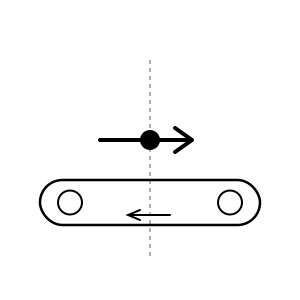
#051 Friction vs Velocity

Productivity

Removing a single friction step doubles throughput and execution speed. • Memangkas 1 klik atau langkah friksi melipatgandakan kecepatan eksekusi.

#052 The 2-Minute Rule

Productivity

If an action takes less than two minutes, execute it immediately without scheduling. • Jika tugas butuh waktu kurang dari 2 menit, kerjakan detik ini juga.

#053 Batch Processing

Productivity

Grouping similar micro-tasks together to minimize context switching overhead. • Menggabungkan tugas sejenis untuk dikerjakan sekaligus dalam 1 sesi.

#054 Timeboxing Grid

Productivity

Locking dedicated calendar blocks for critical work before the day begins. • Mengunci blok waktu spesifik untuk tugas penting sebelum hari dimulai.

#055 Attention Residue

Productivity

Shifting between tasks leaves lingering cognitive residue that impairs focus. • Beralih tugas meninggalkan sisa pikiran yang merusak kualitas tugas baru.

#056 Energy Curve Management

Productivity

Matching your most demanding cognitive work to your natural daily energy peaks. • Cocokkan tugas tersulit pada jam puncak energi alami tubuh Anda.

#057 The Habit Loop

Productivity

The neurological pattern of Cue, Craving, Response, and Reward. • Pemicu → Rutinitas → Hadiah: Anatomi kebiasaan otomatis manusia.

#058 Context Switching Penalty

Productivity

Each disruption incurs a 20+ minute penalty to regain deep cognitive flow. • Setiap interupsi membutuhkan 20+ menit hanya untuk kembali ke ritme semula.

#059 Task Prioritization Hopper

Productivity

Placing large rocks into the container before filling it with pebbles and sand. • Masukkan batu besar (prioritas utama) ke toples waktu sebelum kerikil dan pasir.

#060 The 1% Rule Staircase

Productivity

A 1% daily marginal improvement accumulates into significant long-term progress. • Perbaikan 1% setiap hari secara konsisten membangun tangga kesuksesan.

#061 Feedback Loops

Systems

Cybernetic regulation: Routing real-time output measurements back into input controls to achieve autonomous systemic equilibrium. • Sistem sibernetika: Mengalirkan data keluaran kembali ke modul masukan secara berulang untuk penyesuaian stabilitas otomatis.

#062 Decoupled Architecture

Systems

Fault isolation: Decoupling component dependencies so that critical failures in one domain cannot cascade across the system. • Arsitektur modular terurai: Memisahkan ketergantungan antar-komponen agar kegagalan fatal pada satu node tidak melumpuhkan sistem.

#063 Technical Debt

Systems

Technical debt mechanics: Sub-optimal engineering shortcuts taken for immediate speed compound into crippling operational drag over time. • Hukum utang teknis: Mengambil kompromi arsitektur demi kecepatan rilis hari ini membebankan bunga berupa kelambanan pengembangan esok hari.

#064 Redundancy & Failover

Systems

Automated standby secondary paths that activate immediately upon primary failure. • Jalur cadangan otomatis yang aktif saat jalur primer mengalami gangguan.

#065 Modular Snap Blocks

Systems

Standardized interfaces that allow components to swap without structural redesign. • Blok terstandarisasi yang bisa dibongkar-pasang dengan mudah tanpa merusak struktur.

#066 Black Box vs Transparent

Systems

Hiding internal complexity behind clean, standardized input/output interfaces. • Menyembunyikan kerumitan internal di balik antarmuka input-output yang sederhana.

#067 Single Point of Failure

Systems

A vulnerable system link whose failure incapacitates the entire chain. • Satu titik lemah yang jika rusak akan melumpuhkan seluruh rantai kerja.

#068 Async Message Queue

Systems

Buffering workload to decouple producer throughput from consumer capacity. • Antrean pesan yang menyeimbangkan beban antara produsen dan konsumen tugas.

#069 Monolith vs Microservices

Systems

Single unified core versus independent distributed service network. • Satu kubus raksasa terpadu vs jaringan puluhan layanan kecil yang fleksibel.

#070 Rate Limiting Valve

Systems

Protective throttling valves that shield backend services from traffic surges. • Katup pengaman yang membatasi volume request agar server tidak tumbang.

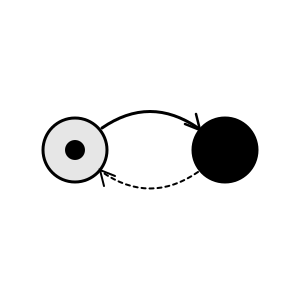
#071 State Machine Flow

Systems

Deterministic systems transitioning through explicit, valid state triggers. • Status sistem yang bertransisi secara teratur berdasarkan pemicu yang valid.

#072 Cache Pyramid

Systems

Tiered memory hierarchies: ultra-fast low-capacity cache over high-capacity persistent storage. • Tingkatan memori: Memori kecil super-cepat di puncak vs Memori besar lambat di dasar.

#073 Circuit Breaker Pattern

Systems

Temporarily interrupting connection calls to failing services to allow recovery. • Memutus koneksi otomatis saat error melonjak agar sistem bisa pulih sendiri.

#074 Pipeline Assembly

Systems

Sequential processing where the validated output of stage one feeds stage two. • Proses berantai di mana output tahap 1 langsung menjadi input tahap 2.

#075 Load Balancer Split

Systems

Distributing incoming client requests evenly across available infrastructure nodes. • Membagi lalu lintas request secara merata ke seluruh armada server.

#076 Data Lake vs Warehouse

Systems

Raw multi-format repositories versus highly curated structured analytical schemas. • Wadah data mentah tak terstruktur vs Struktur matriks siap analisis bisnis.

#077 Idempotency Principle

Systems

Executing an operation repeatedly without altering the final system state. • Eksekusi operasi berkali-kali menghasilkan dampak akhir yang tetap sama persis.

#078 Event-Driven Hub

Systems

Centralized broker dispatching events asynchronously to decoupled subscribers. • Pusat broker yang menyiarkan peristiwa kepada subscriber yang berkepentingan.

#079 High Availability Ring

Systems

Interconnected nodes maintaining real-time heartbeat and data replication. • Cincin server yang saling menjaga sinkronisasi status untuk nol downtime.

#080 Agile Iteration Sprint

Systems

Rapid cycles: Design, Build, Measure, and Adapt based on real usage data. • Putaran cepat: Rancang → Bangun → Uji → Evaluasi.

#081 The Empathy Gap

Psychology

Failing to anticipate how different emotional states alter user decisions. • Asumsi kita tentang user sering berbeda drastis dari realitas mereka.

#082 Anchoring Effect

Psychology

Cognitive anchoring: The initial datum introduced disproportionately biases and bounds all subsequent rational valuations. • Bias penjangkaran: Angka atau kesan pertama yang diperkenalkan mendistorsi kerangka penilaian dan negosiasi secara tidak proporsional.

#083 Loss Aversion (2x Pain)

Psychology

Kahneman & Tversky's loss aversion: The psychological distress of a loss is experienced with twice the intensity of an equivalent gain. • Prospek Kahneman & Tversky: Beban psikologis rasa rugi dirasakan 2 hingga 2,5 kali lebih menyakitkan dibanding nikmat keuntungan setara.

#084 Confirmation Bias Filter

Psychology

The tendency to accept information that confirms prior beliefs and discard contradictory data. • Otak hanya menyerap bukti yang mendukung keyakinan awal dan membuang sisanya.

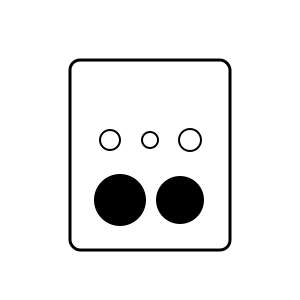
#085 Cognitive Load Overflow

Psychology

Working memory is constrained to processing roughly 4 distinct items simultaneously. • Otak manusia hanya mampu menampung 4 bongkah informasi baru sekaligus.

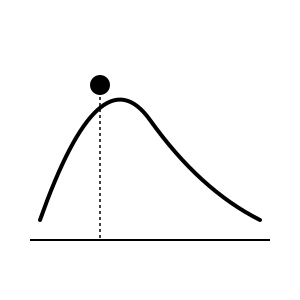
#086 The Dunning-Kruger Curve

Psychology

The Dunning-Kruger curve: Perceived confidence peaks at superficial familiarity before crashing as true operational depth is uncovered. • Paradoks Dunning-Kruger: Keyakinan semu memuncak saat pemahaman masih dangkal, lalu runtuh ketika kerumitan riil mulai dipahami.

#087 Overcoming Inertia

Psychology

The initial activation energy required to begin is far higher than energy to maintain motion. • Energi terbesar dihabiskan untuk mendorong batu pertama kali agar mulai bergulir.

#088 The Scarcity Urgency

Psychology

Perceived value and urgency increase sharply when availability or time is constrained. • Nilai sesuatu melonjak di mata manusia saat jumlah atau waktunya terbatas.

#089 The Framing Spotlight

Psychology

Presenting identical data through different semantic frames alters conclusions. • Informasi yang persis sama terlihat berbeda tergantung sudut sorot bingkainya.

#090 The Spotlight Effect

Psychology

Overestimating how much external observers notice our minor flaws and missteps. • Kita mengira semua orang memperhatikan kesalahan kita, padahal mereka sibuk dengan diri sendiri.

#091 The Halo Effect

Psychology

A single positive attribute creating an overarching favorable impression of the whole. • Satu kelebihan menonjol menciptakan kesan positif menyeluruh pada hal lainnya.

#092 Reciprocity Loop

Psychology

Providing upfront value naturally stimulates a psychological drive to return the favor. • Memberi nilai tanpa pamrih memicu dorongan psikologis untuk membalas budi.

#093 Sunk Cost Trap

Psychology

Continuing an unproductive venture simply because past resources cannot be recovered. • Terus bertahan pada keputusan rugi hanya karena terlanjur menginvestasikan waktu/uang.

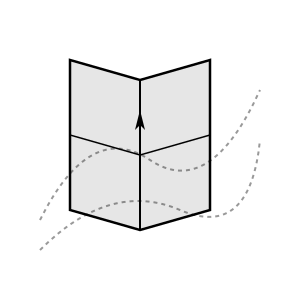
#094 The Blind Spot

Psychology

Critical angles invisible to the individual but easily observed by external peers. • Area kritis yang tidak terlihat oleh mata kita sendiri tapi jelas bagi orang lain.

#095 The Overton Window

Psychology

The range of policies and ideas considered mainstream and acceptable by the public. • Rentang ide yang dianggap dapat diterima oleh publik pada satu masa tertentu.

#096 Active Listening

Psychology

Listening to fully comprehend rather than merely waiting for a turn to speak. • Mendengar untuk benar-benar memahami, bukan sekadar menunggu giliran bicara.

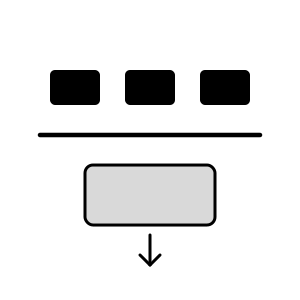
#097 Storytelling Arc

Psychology

The narrative structure: Context, Inciting Incident, Climax, and Resolution. • Struktur narasi presentasi: Pengenalan → Konflik → Klimaks → Solusi.

#098 Status Quo Bias

Psychology

The default preference to keep things as they are due to fear of change. • Kecenderungan manusia memilih keadaan sekarang dibanding ketidakpastian perubahan.

#099 The Trust Equation

Psychology

The Trust Equation: Credibility, Reliability, and Intimacy are immediately nullified when perceived Self-Orientation is elevated. • Persamaan kepercayaan Charles Green: Kredibilitas dan keandalan Anda runtuh seketika saat lawan bicara mencium motif mementingkan diri sendiri.

#100 First Impression Anchor

Psychology

Initial perceptions formed within seconds that color subsequent assessments. • Opini audiens terbentuk dalam 7 detik pertama dan mewarnai sisa presentasi.

Copied to clipboard